Multiplication table is one of the most essential tools for helping students build strong numerical foundations and improve mental arithmetic skills. Learning it at an early age supports quick problem-solving, enhances number sense, and makes advanced mathematical topics easier to understand later on. Because it visually organizes repeated addition, the table allows learners to see number patterns clearly and confidently apply them in everyday situations. Regular practice with colorful charts, interactive games, or worksheets also increases retention and boosts motivation.
Multiplication table becomes even more valuable as students progress through school, where multi-step operations and word problems demand faster recall. Mastering these number relationships helps learners approach math tasks with reduced anxiety and higher accuracy. Moreover, understanding the logic behind multiplication -not just memorizing results- strengthens critical thinking and analytical reasoning. Whether used at home or in the classroom, it remains a timeless educational resource that lays the groundwork for long-term mathematical success.
Multiplication Chart
Understanding a multiplication chart is one of the most effective ways to build a strong foundation in mathematics, especially during the early years of education. Because the chart organizes numbers into clear rows and columns, students quickly notice how patterns emerge and how repeated addition transforms into multiplication.
This structured layout not only helps with memorization but also supports conceptual understanding, allowing children to see relationships among numbers rather than treating multiplication as a set of isolated facts. Teachers often introduce the multiplication chart before moving on to more complex operations because it empowers learners with confidence and speed.
A multiplication chart also improves problem-solving skills beyond simple calculations. When learners recognize visual patterns -such as diagonal squares, mirrored values, and growing sequences- they begin to understand why multiplication works the way it does. This deeper insight leads to stronger analytical thinking and smoother transitions into subjects like division, fractions, and algebra. To reinforce learning, students can use various strategies such as pointing, coloring, or covering sections of the chart to test recall. Common benefits include:
- Faster mental math performance
- Better pattern recognition
- Increased confidence in solving multi-step problems
- Stronger preparation for upper-level mathematics
With regular practice, the multiplication chart becomes more than just a classroom tool; it evolves into a reliable guide that supports a lifetime of mathematical learning.
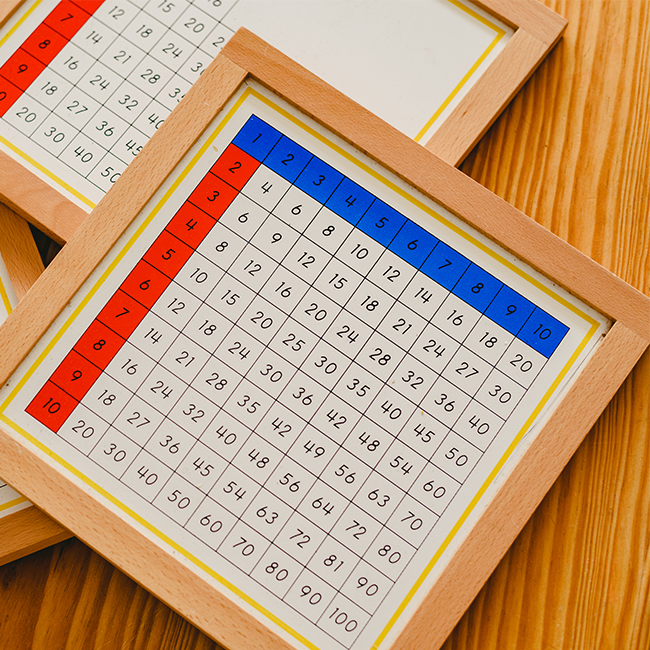
Math Multiplication Table
The math multiplication table remains one of the most essential learning resources for students developing numerical fluency. By presenting multiplication facts in a consistent and accessible format, the table makes it easier for learners to solve everyday math problems and build automatic recall. This efficiency becomes especially important as students progress to more advanced topics, where multiplying numbers quickly allows them to focus on complex reasoning instead of basic computation. A well-designed multiplication table also reduces math anxiety, giving learners a sense of structure and predictability during practice.
Educators frequently integrate the multiplication table into lessons because it adapts to different learning styles. Some students prefer visual aids, others benefit from repetition, and many learn best through hands-on activities. The table supports them all, offering a solid starting point for mathematical exploration. To enrich the learning experience, teachers often incorporate:
- Highlighting or coloring multiples to spot numerical patterns
- Timed drills to build speed and confidence
- Real-life examples to show how multiplication applies outside the classroom
- Games or puzzles that turn practice into an engaging challenge
As students advance into division, ratios, percentages, and algebraic expressions, the math multiplication table acts as a bridge between simple arithmetic and higher-order thinking. Its long-lasting value lies in its ability to make complex ideas more approachable by reinforcing the fundamentals of number relationships.